Foam recycling is technically feasible, and recycled foam materials are already used in many everyday products. The challenge for many businesses is turning loose foam waste into a material that can be stored and transported economically. Because foam occupies considerable space while weighing very little, many curbside programs do not accept it, and recyclers may be reluctant to collect it without prior volume reduction.
Foam waste includes several different materials. EPS is polystyrene-based foams, while EPE is made from polyethylene and EPP from polypropylene. These materials have different melting and processing characteristics, as well as different downstream applications. Packaging foam may also arrive with other materials mixed into the load, which can affect the quality of the recycled output

For this reason, foam should first be separated according to material type. EPS, EPE and EPP should not be treated as one mixed foam stream. Businesses that regularly generate foam waste can collect each material separately before sending it for volume reduction and further recycling.
The main purpose of a foam recycling machine is to reduce the volume of loose material. This can free storage space, reduce transportation frequency and prepare the foam for downstream processing. A foam densifier first crushes the waste into smaller pieces and then uses a heated screw to soften and compress the material into dense ingots
GREENMAX recommends its foam densifier for factories, warehouses and recycling facilities that handle foam waste in steady volumes. Depending on the material and operating conditions, the equipment can achieve a compression ratio of up to 90:1. Selected large-capacity models can process up to approximately 300 kg of foam per hour under suitable conditions. This is processing capacity, rather than machine power.
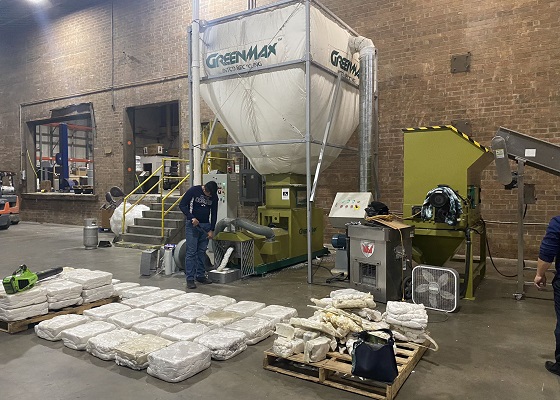
GREENMAX foam densifier combines crushing, heating and extrusion in one process. The operator feeds the loose foam into the hopper, and the machine converts it into compact ingots that are easier to stack, store and transport. Because the equipment uses hot-melt technology, energy consumption should be included in the operating-cost calculation. The corresponding advantage is a higher compression ratio and denser output, which can make long-distance transportation and downstream recycling more economical.
After densification, the foam ingots can be granulated and processed into recycled plastic pellets. Depending on the material type and quality, these pellets can be used to manufacture products such as picture frames, decorative mouldings and plastic profiles. INTCO Recycling may purchase qualified densified foam according to its material, quality, quantity, location and current purchasing requirements.
FAQ
1.What is a foam densifier?
A foam densifier is a recycling machine that crushes and hot-melts loose foam into dense ingots. It is used to reduce storage and transportation volume before further recycling.
2.What compression ratio can a foam densifier achieve?
GREENMAX foam densifier can reduce foam volume by up to 90:1. Actual performance depends on the material type, density and operating conditions.
3.What happens to foam after densification?
The dense foam ingots can be granulated and processed into recycled plastic pellets. These pellets can then be used to manufacture new plastic products.