In modern supermarket logistics and product displays, EPE (Expanded Polyethylene, commonly known as pearl cotton) foam is widely used to protect fragile items such as glassware, ceramics, fruit gift boxes, and small home appliances. Although EPE has good cushioning properties, it is often discarded as single-use packaging after use, resulting in a large accumulation of foam waste that is difficult to handle and pollutes the environment.The introduction of Foam Densifier provides supermarkets with a low-cost, high-efficiency, sustainable recycling path for EPE foam.Current Status of EPE Foam Waste
Taking a large supermarket as an example, hundreds of fragile products received from suppliers and distribution warehouses need to be processed daily. Most of these products’ outer packaging contains EPE foam pads, corner protectors, trays, etc., which have the following characteristics:
Large in volume but low in density, taking up a lot of storage and waste space;
Cannot be directly degraded, easily mixed with household waste in landfills;
Cannot be processed by conventional compactors, and contains a small amount of adhesives that are difficult to incinerate;
Cannot be recycled or reused after disposal, resulting in resource waste.

Foam Densifier:
The Recycling Tool for EPE Foam
The Foam Densifier is a device that “thermally melts and reduces” EPE foam into high-density block plastic through heating and screw extrusion. Its working principle is as follows:Crushing: Initially shred the EPE foam to facilitate melting;Heating and Melting: Use the built-in high-temperature system to soften and melt the foam;Extrusion and Molding: Extrude strip-shaped or block-shaped high-density plastic (commonly known as “EPE bricks”), making it easy for storage and transportation.Design of EPE Foam Recycling Process in Supermarkets
Classification and Collection: Set up foam recycling bins during the unboxing or display stages, with dedicated personnel separating EPE foam from other waste.Centralized Processing: Transport the foam to the equipment operation area and uniformly thermally melt and compress it in the Foam Densifier.
Finished Product Storage: The output EPE thermal melt bricks have a small volume and high density, allowing for neat stacking while awaiting sale or transfer.Recycling and Reuse: After purchasing EPE bricks, recycling companies use them for regranulation to manufacture products such as trash cans, floor mats, and plastic pipes.
A large chain supermarket’s EPE foam recycling project
This supermarket processes a large number of imported fruits, ceramic gift boxes, and small appliance packaging daily, with EPE foam waste averaging 60-100 kilograms per day. Since introducing a small Foam Densifier in 2023:
About 2 tons of EPE foam are compressed and recycled each month; the resulting heat-melted blocks are sold regularly to local plastic recyclers;the project has been awarded the title of “Green Store” by the local city management department and has been listed as a demonstration point for the circular economy.
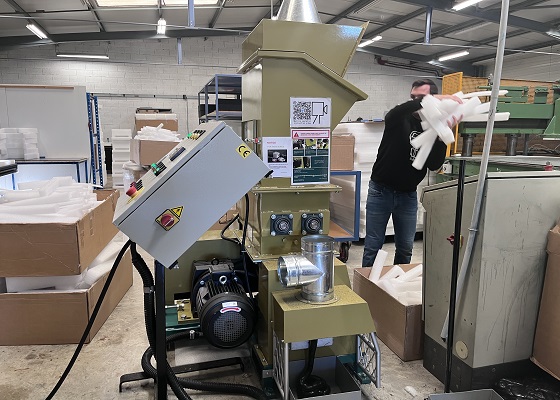
EPE foam is not “waste,” but a buried resource. With the intervention of the Foam Densifier, the supermarket can not only achieve environmental protection and emission reduction but also gain substantial economic returns from resource recycling. In the future, more “green supermarkets” will quietly start from this step.