It is also recycling. Glass containers can reach a recycling rate of 50%, and more than 181 tons of waste can be removed from the landfill every month. EPS (also known as styrofoam) containers can only reach a recycling rate of 40.5% even in California, San Francisco, the main recycling city in the United States, and recyclable EPS waste is discarded in the landfill, It has caused pollution for hundreds of years.
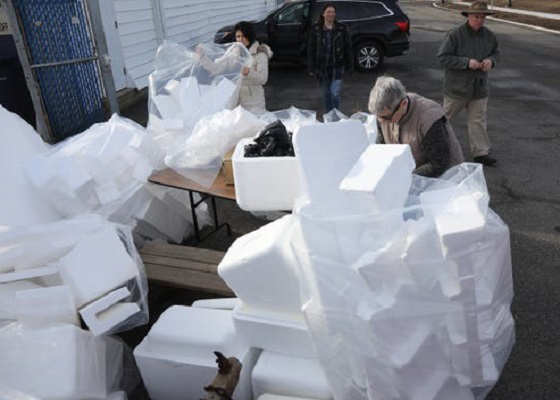
The low recovery rate of EPS containers is related to the recovery efficiency of EPS. EPS has the characteristics of expansion and stability, especially suitable for some fresh and food containers, such as fish boxes, cups, plates, banana trays, etc. These EPS products can be recycled completely, but the direct recovery of EPS waste containing 98% air content is not only extremely inefficient but also requires high cost.
Therefore, if fishermen want to carry out styrofoam fish boxes recycling, or recyclers want to recycle EPS cups and plates, the first thing to do is to find a professional recycling company and ask it how to improve the recycling efficiency of EPS. Intco Recycling, headquartered in California, is such a company. As an EPS recycling specialist, it provides customers with a complete EPS recycling project.

INTCO found that if a compression link is added in the recycling process, the efficiency of EPS recycling will be significantly improved. According to this discovery, INTCO has developed an EPS densifier with a high compression ratio. The machine is equipped with a hopper bin, rotary cutter, hot-melt screw, heating ring, etc. it compresses EPS waste semi-automatically, and the volume ratio of EPS ingot to EPS waste reaches 90:1. The storage and transportation efficiency of high-density EPS ingot is much higher than that of EPS waste, so as to greatly reduce the recovery cost.

Centered on EPS densifier, Intco has designed a complete EPS recycling project, including solving the sales problem of EPS ingot for customers. EPS ingot can be sold as a commodity, with end-markets such as photo frames, stationery, clothes hangers, wood-like materials, etc. Intco will promise the machine customers that it will buy back the EPS ingot produced at the market price. Of course, the customers can also sell it by themselves.
If you are a company that has a large number of EPS waste and has not yet recycled because of the low efficiency and high cost of EPS recycling, why not talk to companies like Intco recycling?