EPS dust is usually fine particles formed by grinding or crushing waste EPS foam products. These powders can play an important role in the recycling and reuse process, especially when processed through EPS densifiers. EPS dust is usually formed by crushing discarded EPS products, such as packaging materials, insulation materials, etc. Especially during the cutting and production of EPS, a large amount of EPS dust will be produced. Although this dust is not as easy to recycle as EPS scraps, it is 100% recyclable. During the collection process, attention should be paid to controlling the spread of dust for subsequent processing.
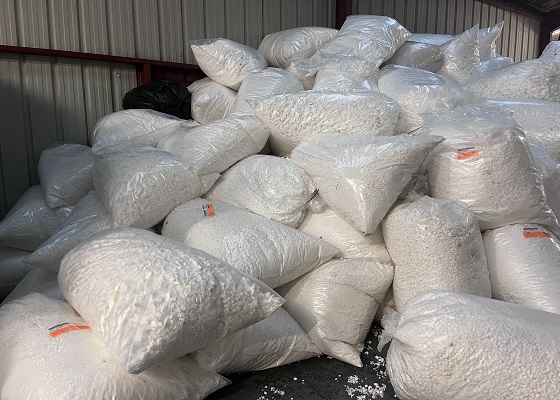
In fact, recycling EPS dust is not recycled separately. Generally, when recycling EPS dust, it is recycled together with EPS waste in blocks. In the process of recycling with EPS densifier, we combine EPS blocs with EPS dust. At the same time, it is introduced into the feeding bin of the EPS densifier, and then crushed, heated and melted together to achieve final compression. The compression ratio of this EPS densifier can reach 90:1.
Using EPS densifier to process EPS dust can effectively achieve convenient management of EPS dust. If EPS dust is not compressed in time, these small dusts are likely to be scattered into the natural environment, causing serious secondary pollution to the environment. , and this kind of EPS dust is not as easy to collect as EPS lumps, and is even more difficult to collect than EPS beads, so we often use microplastics to define them

There are many successful cases of EPS dust recycling in GREENMAX, and it has successfully helped customers solve long-standing problems. If you are also interested in recycling EPS dust, you can contact GREENMAX at any time to help you develop a customized plan for free.