With the increase in global environmental awareness and the advancement of garbage classification policies, the recycling and reuse of household appliance foam packaging has become an important issue. A large amount of foam packaging is often used in the transportation and sales of home appliances. These foams (mainly composed of polystyrene, referred to as EPS) have the advantages of being lightweight, cushioning, and shockproof. However, if not processed after disposal, it will cause a huge burden on the environment. . In order to solve this problem, the application of foam densifier is particularly important.

Foam packaging recycling challenges
Although foam packaging materials are easy to recycle, their large volume and low density make transportation and storage costs high. In addition, untreated foam is easily contaminated or damaged, affecting subsequent recycling efficiency. Therefore, how to improve the recycling economy and environmental protection of foam packaging has become key.
The function and principle of Foam densifier
Foam densifier is a kind of equipment specially used to compress and process foam materials. It compresses bulky foam into high-density blocks through heating, compression, etc., thus greatly reducing storage and transportation costs. There are two main types of foam compactors:
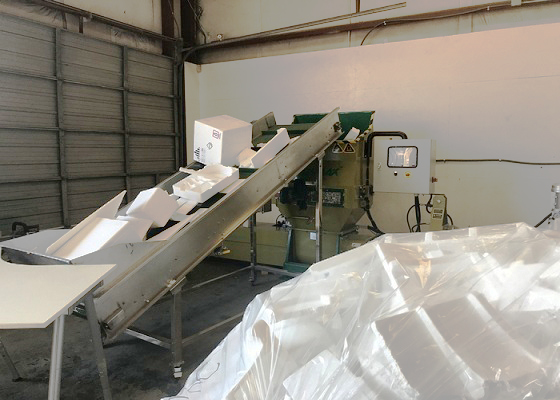
The foam is melted by heating and then re-solidified into blocks. The compression efficiency is higher and it is suitable for large-scale foam recycling. The compression ratio of GREENMAX foam densifier can reach 90:1, which is a recycling equipment with extremely high compression ratio.
The compressed foam material has a significantly higher density and can be easily transported to a recycling plant for subsequent processing, such as being made into plastic pellets for the production of new plastic products.