With the continuous growth of global consumption of seafood, salmon has become one of the important categories in the supermarket and catering industry. To ensure freshness and hygiene during transportation, EPS Expanded Polystyrene Foam Fish Boxes are widely used for salmon packaging and cold chain distribution. Although this foam box has excellent thermal insulation performance and lightweight characteristics, if not properly disposed of after use, it is easy to cause white pollution and take up a lot of landfill space.

Difficulties in the recycling of foam fish boxes
EPS foam fish box has the following processing difficulties:
Large size and low density: occupies transportation and stacking space, increasing recycling costs.
Easy to contaminate: contains residual fish, ice water or plastic bags that need to be cleaned before entering the recycling process.
Manual sorting is difficult: When the quantity is large, the manual processing efficiency is low, and human resources are wasted.
Application benefits of Foam Compactor:
The Foam Compactor is a specialized equipment for compressing and reducing volume foam plastics, ideal for handling EPS foam fish boxes used in salmon packaging. Its core benefits include:
Efficient volume reduction
Foam Compactor can compress loose and bulky foam fish boxes into high-density lumpy materials with a compression ratio of up to 50:1, significantly reducing transportation and storage costs.
Environmentally friendly reuse
The compressed foam can be used as a recycled raw material for the production of plastic products such as photo frames, hangers, and decorative boards, realizing resource recycling.
Automate processes
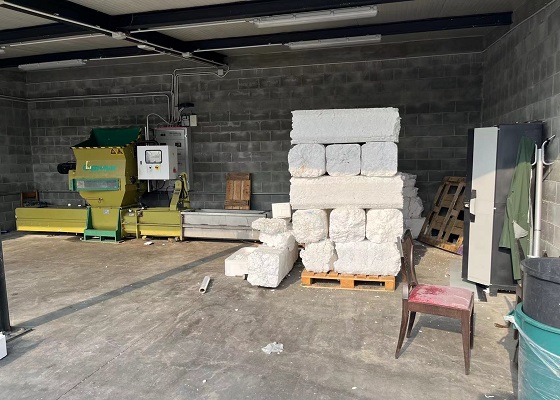
Some models are equipped with automatic feeding, foaming and compression to improve processing efficiency and are suitable for use in seafood processing plants, fishing port recycling stations and large wholesale markets.
Reduce transportation costs
The compressed foam blocks are easier to load and stack, significantly reducing the number and cost of transporting them to the recycling plant.
Foam Compactors have been widely deployed in ports and cold chain centers in major salmon exporting countries such as Norway, Canada, and Japan. At Singapore’s Jurong Fishing Port, hundreds of EPS fish boxes are recycled every day, and the waste foam can be directly compressed on site and transported to the recycling center for processing through on-site foam compression equipment.
Recycling salmon foam fish boxes is not only a key part of reducing white pollution and practicing the concept of environmental protection, but also an important step to promote the sustainable development of the seafood supply chain. As an efficient volume reduction and recycling tool, the Foam Compactor has become an ideal choice for foam packaging recycling. With the policy support and environmental awareness, the equipment will play a greater role in more fishery distribution centers, seafood markets and food processing enterprises.